The Difference Between Holding Data And Owning It
In college, we learned about MySQL. My first website ran on it.
The more I worked with data, the more I noticed that every database has its own character. Some are built for transaction speed. Some for scale. Some are relational. Others are document stores, or analytical warehouses built to answer a different kind of question entirely.
Then there’s Excel. A spreadsheet holds data, shapes it, answers the question in front of you. But holding data and serving as the truth are not the same job.
In my early ERP days, accounting teams asked for database extracts constantly. We pulled records from SQL Server. They turned the rows into a model they could report from. That spreadsheet served its purpose for exactly as long as it took someone to open it. The moment it closed, it was already out of date. The ERP behind it held the truth that mattered.
So when a client asks what Dataverse is, telling them it’s a Microsoft database misses the point entirely. The real question isn’t what it is. It’s what business outcome it was built to enable.
Data With A Lifecycle
There’s a fundamental difference between a website capturing records and an enterprise process managing customer requests, approvals, risk, and cross functional delivery.
In that second scenario, data doesn’t sit still. It has a lifecycle. It requires normalization, security boundaries, defined relationships, event automation — structure a spreadsheet was never designed to hold.
Dataverse was built for that standard. It gives applications, reporting, and AI a foundation reliable enough to act on.
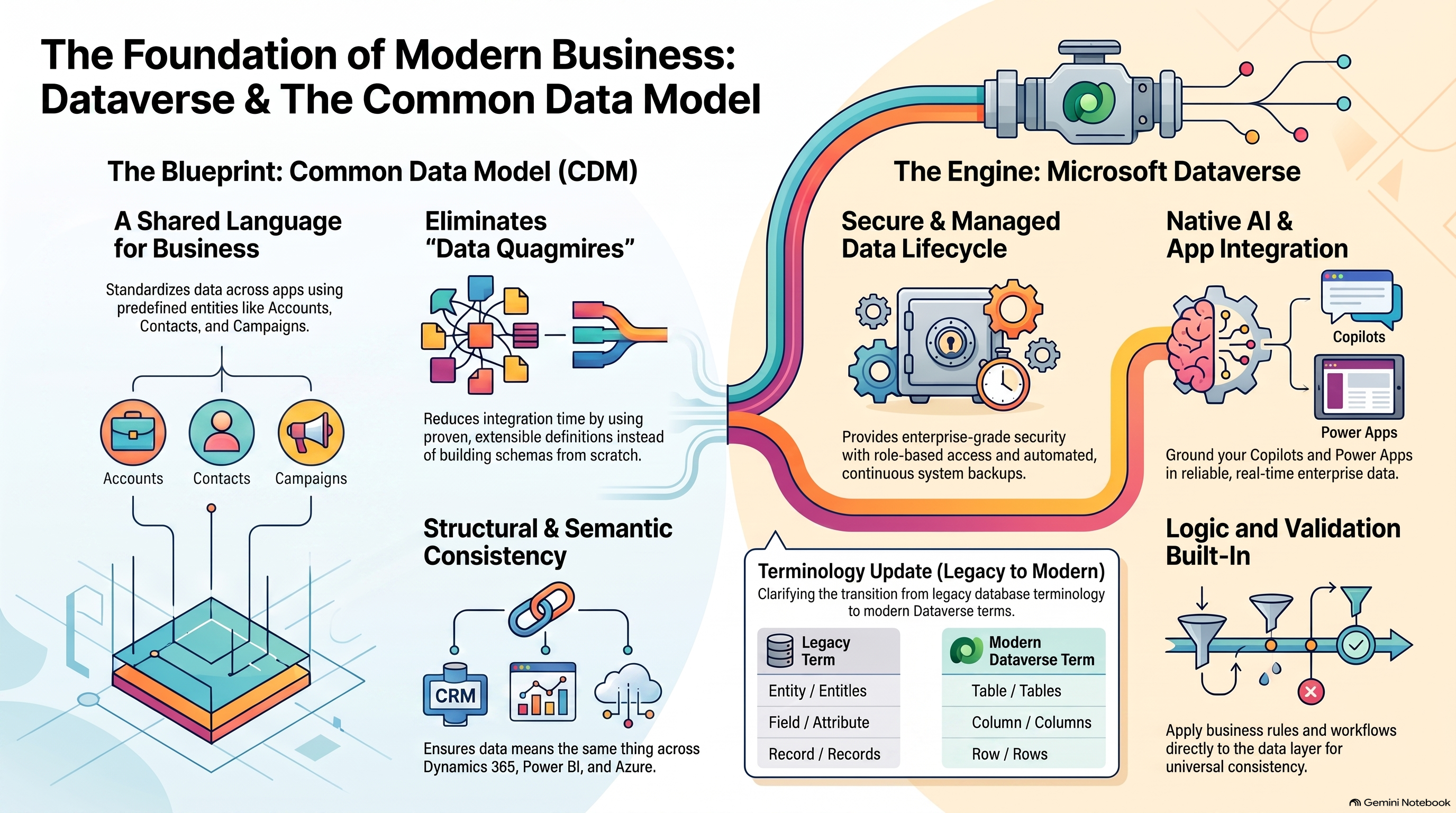
The Common Data Model
Every Dataverse environment ships with the Common Data Model already in place.
The Common Data Model is not Dataverse. It’s the blueprint underneath it — standard business entities like accounts, contacts, activities, and opportunities, along with the relationships that connect them.
Most organizations don’t actually struggle with storing data. They struggle with agreeing on what it means. One department tracks a customer. Another manages an account. A third bills a client. Every integration, every board report, every AI deployment stalls at the same point: reconciling whether those three records describe the same thing.
The Common Data Model settles that question on day one. Teams build on proven definitions instead of untangling conflicting systems after the damage is done. Dataverse is simply where that shared language becomes operational.
It also saves teams from a mistake I’ve made myself: overbuilding. Instead of designing a schema from nothing, you extend standard entities to fit what’s actually unique about your business. The core stays disciplined. Predictable. Ready to scale without a rewrite.
The word “common” suggests every business has the same problem. It doesn’t, and they don’t. It’s a starting point, not a universal answer. I wish I’d understood that when I was architecting on what was briefly called Dataflex — I’d have leaned on the CDM from day one instead of boiling the ocean, which I’m fairly sure I did more than once.
What Dataverse Is — And What It Isn’t
What it is
So what’s the differentiator? Why does a business actually need it? Simply put — it doesn’t. SQL Server, PostgreSQL, Salesforce, ServiceNow, Oracle, custom architecture — all of them can do a version of what Dataverse does.
The difference is packaging. Dataverse arrives opinionated: a preferred way to model business data, manage access and identity, build apps, automate work, package solutions, and deploy them across environments. And because it’s Dataverse, you’re not just getting a database. You’re getting the door into the Microsoft ecosystem — Graph, first party and third party connectors, all of it.
What it isn’t
Dataverse is not the default for every workstream, and I’d be lying if I told a client otherwise. I would never tell a customer to replace their ERP with Dataverse. I would tell them how to run Dataverse alongside it.
The job of an ERP is to run the business: procurement, inventory, accounts receivable, accounts payable, general ledger, manufacturing, order fulfillment. Let it do that job.
Dataverse’s job is different. It’s the secure layer that connects those transactions to the people and processes surrounding them. It doesn’t need to be authoritative. It needs to be adjacent.
What I like about Dataverse, professionally, is that it can be a bolt on. Architect it correctly, and you can turn it off tomorrow without touching the system of record underneath it.
The Proceeding To The Preceding
Consider this the prelude. Next, we talk governance. If Dataverse is going to hold data that matters, it has to be managed like it matters — not treated as an unmanaged pile of entities and apps.
We’ll talk about how to empower makers and business units without losing control of the environment. Then we’ll get practical: which workstreams belong in Dataverse, and which ones don’t. Last, I’ll show you how Dataverse stays secure even as that data surfaces in the places people actually want to work.